Airbnb Operating Expense Tracking: Build a Complete Cost System
TL;DR
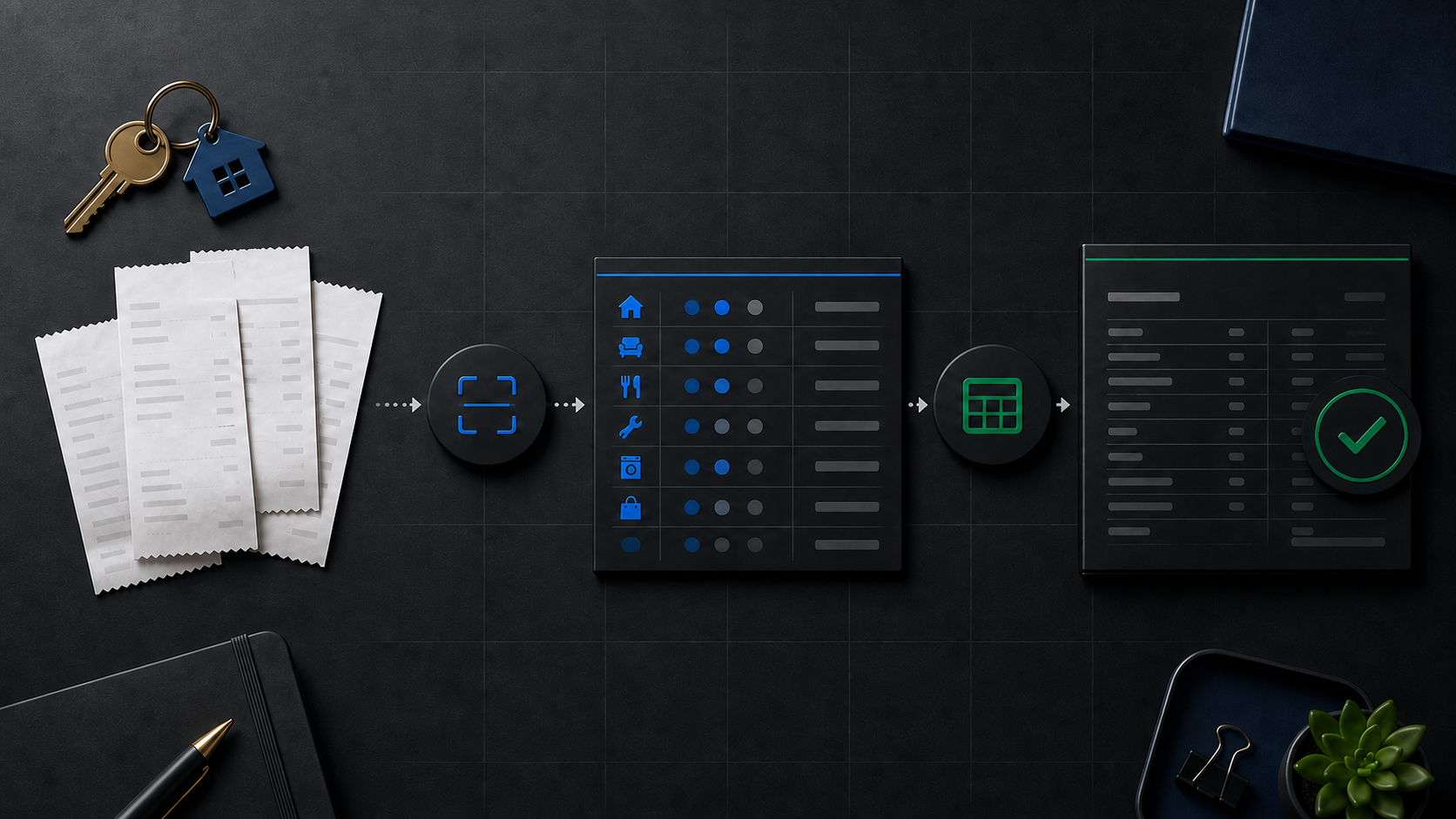
This optional internal framework groups selected costs into four buckets: recurring property costs, per-stay variable costs, platform-reported fields, and shared portfolio costs. You assign each selected cost a label, record it in your own ledger, then check it against named source records.
The labels you choose are internal planning tools. They do not set tax treatment, accounting classification, or legal obligations. Build the system to answer your own operating questions, not to satisfy an external standard.
Educational scope: This worksheet uses operator-entered assumptions for internal planning only. It does not determine tax, accounting, legal, valuation, investment-return, or performance outcomes.
Hypothetical opening example: For January 2026 in US dollars, an operator enters $1,200 of selected costs from named records: $500 recurring property, $300 per-stay, $100 in a platform-reported field classified by the operator as a separate cost, and $300 shared portfolio allocation. The declared buckets total $500 + $300 + $100 + $300 = $1,200.
Key Facts
| Metric | Value | Source |
|---|---|---|
| Airbnb earnings export fields | Earnings, host service fees, optional cleaning fees, withheld taxes, listings, payout methods, date ranges | Airbnb Help: Earnings Data |
| Export completeness | The Airbnb page enumerates report fields; separate operator records must be checked for any additional activity in the worksheet scope | Airbnb Help: Earnings Data |
| Core bookkeeping records | Revenue, expenses, accounts receivable, accounts payable, available cash, bank reconciliation | SBA: Manage Your Business |
| Cost distinction supported by SBA | Development costs versus operations costs; recurring versus nonrecurring costs | SBA: Manage Your Business |
Define the Decision Your 2026 Cost System Must Support
Before building any worksheet, name the question it must answer. A cost system built to track cash flow looks different from one built to compare properties. Pick one primary question first, then design the labels around it.
Common operator questions include: Which costs repeat every month regardless of bookings? Which costs rise when stays increase? How do shared costs get split across multiple listings? What does the Airbnb export show, and what must I record myself?
Each question can point to a different cost bucket. The four buckets below are one optional internal framework, not a complete or mandatory classification. Use only the labels that match your declared question and records.
Recurring Property Costs in 2026
For this optional framework, recurring property costs are operator-entered amounts assigned to a repeating schedule. The SBA distinguishes recurring from nonrecurring costs in its business finance guidance. Define each selected label from the operator's own record rather than treating this bucket as a formal classification.
Fixed versus Variable Recurring Costs
Recurring is a timing label: it means a line follows a repeating schedule, consistent with the recurring and nonrecurring distinction above. Fixed and variable are separate, operator-defined worksheet labels that describe how an amount responds to a declared production or service activity during the stated period. For this worksheet, mark a cost fixed when it does not change as that activity increases or decreases, and mark it variable when the operator's actual agreement and records show that it changes with the activity. Record cadence separately as monthly, quarterly, or annual, and use unknown when the activity relationship is not established.
Per-Stay Variable Costs
For this optional framework, a per-stay label holds an operator-entered cost that the operator's own record ties to a stay. Do not assume that every item under a familiar label changes with booking volume; define the relationship from the underlying record.
Record the named source document for each selected per-stay cost in the operator's ledger. Use the listed Airbnb report fields only for platform-reported values, and use the operator's declared source documents for separate per-stay costs. Record any unresolved relationship as unknown.
Platform and Payout Fields From the Airbnb Export
The Airbnb earnings export provides specific fields: earnings, host service fees, optional cleaning fees, withheld taxes, listings, payout methods, and date ranges. Airbnb Help: Earnings Data Each field is a reported value from the platform side of the transaction.
Classify Each Field Before You Use It
Before you add or subtract any export field in your ledger, decide how that field relates to your own records. Four relationships are possible:
- Embedded: The platform amount is already included in a figure you record elsewhere. Do not double-count it.
- Separate: The platform amount is distinct from your own record. Add it as its own line.
- Excluded: The field does not appear in your cost ledger at all. Note why.
- Unknown: You cannot yet confirm the relationship. Flag it for investigation before closing the period.
Host service fee and optional cleaning fee are names of fields listed in the Airbnb earnings report guide. The source does not establish whether either field is embedded in or separate from another selected input. Classify every material relationship from the operator's actual earnings or payout record before adding or subtracting a field.
Use the Airbnb report for its listed fields, and use named operator records only for their declared worksheet fields. Do not infer a relationship between those sources. Record an unresolved relationship as unknown and keep it outside calculated totals.
Shared Portfolio Costs Across Multiple Listings
When one operator-entered cost is assigned across more than one property, choose and disclose an internal allocation rule. The rule belongs to this worksheet and must use the same declared period and units as the source cost.
Choose and Disclose Your Allocation Rule
For an equal split, allocated cost per property equals the shared cost in dollars divided by the positive whole-number property count. With a positive property count, a zero shared cost allocates zero dollars to each property. A zero property count makes the result undefined, and a negative count is infeasible. If no shared cost is in scope, allocation is not applicable and no allocation rule is selected.
For a nights-based split, a property's allocation equals shared cost multiplied by that property's declared available nights divided by total declared available nights for the same period. With a positive total declared-night denominator, a property with zero declared nights receives a zero allocation. For a selected-revenue split, replace nights with that property's selected source-labeled revenue and the matching portfolio total. With a positive selected-revenue total, a property with zero selected revenue receives a zero allocation. A zero denominator is undefined, negative allocation inputs are infeasible for this worksheet, and unknown inputs produce no allocation. Round each property allocation to cents, disclose the rounding rule, and assign any rounding remainder so the property allocations sum exactly to the shared cost.
Bank Reconciliation as a General Finance Function
The SBA identifies bank reconciliation as a general finance-management function in its business finance guidance. This worksheet does not define a platform-specific or vendor-specific reconciliation method.
Do not compare the four cost buckets alone with net cash. Net cash requires beginning cash plus all inflows minus all outflows for the same period, and this worksheet does not collect that complete input set.
Handle Variances Without Assuming a Cause
When a figure does not match, record the variance as unknown. Investigate it from the named operator records for the same period. Do not assign a cause until those records support it, and keep the variance outside calculated totals while it remains unknown.
Worked Hypothetical: One Property, One Month
The following example is entirely hypothetical. It uses made-up figures for illustration only. Period: one calendar month. Unit: one property. All amounts in USD.
Inputs (operator-entered):
- Gross earnings from Airbnb export: $2,400
- Host service fee from Airbnb export: $240
- Recurring property costs (fixed, from operator ledger): $900
- Per-stay variable costs (from vendor invoices): $360
- Shared portfolio allocation (equal split, two properties): $100
Operator classification decision: The host service fee is treated as a separate cost line, not embedded in gross earnings, based on review of the payout statement.
Arithmetic:
- Total costs recorded: $900 + $360 + $100 + $240 = $1,600
- Internal planning result: $2,400 - $1,600 = $800
Rounding: No rounding applied; all inputs are whole numbers.
Zero, negative, and undefined cases: If the selected revenue input is $0 while the four listed cost inputs remain exactly $1,600, the internal result is $0 - $1,600 = -$1,600. This does not imply zero bookings. If a material field relationship is unknown, keep that field outside the total. Per-stay unit cost equals the selected per-stay cost divided by the operator-entered stay count. Zero stays makes that quotient undefined, a negative stay count is infeasible, and no per-stay value is emitted in either case.
This result is an internal planning figure. It does not represent taxable income, net profit under any accounting standard, or a performance benchmark.
Monthly Close Checklist for 2026
- Export the Airbnb earnings report for the closed month.
- Confirm the date range matches your ledger period exactly.
- Classify each export field as embedded, separate, excluded, or unknown.
- Enter the selected recurring property costs from their named source records.
- Enter the selected per-stay variable costs from their named source records.
- Apply your documented shared-cost allocation rule.
- Review the selected worksheet fields for any unresolved relationship or variance.
- Name the operator records needed to investigate each unresolved item.
- Record every variance as unknown and investigate before closing.
- Save all source documents alongside the ledger for the period.
Classification Traps to Exclude From This Worksheet
Several cost questions fall outside the scope of an internal planning worksheet. Do not use this worksheet to answer them.
- Tax deductibility: Whether a cost is deductible is a tax question. The worksheet labels do not determine it.
- Capitalization versus expensing: This worksheet does not determine that classification. See Short-Term Rental CapEx vs. OpEx for a separate educational worksheet.
- Depreciation schedules: Depreciation rules are outside this worksheet's scope.
- Legal compliance: No label in this worksheet confirms legal sufficiency.
- External benchmarks: This worksheet deliberately avoids external cost benchmarks. Your inputs drive the output.
If your break-even occupancy question depends on selected cost totals, use the Airbnb Break-Even Occupancy Calculator with its own declared inputs and denominator rules.
FAQ
How should an Airbnb operator track recurring, per-stay, and shared expenses?
Keep an operator-selected ledger row for each cost label in scope. Assign its frequency and property scope, name its source record, and disclose any shared-cost allocation rule. If a field relationship or variance remains unresolved, record it as unknown, investigate it from the named operator records for the same period, and keep it outside calculated totals. Do not assign a cause until those records support one.
If you want help applying this worksheet to your operation, Book a strategy session.